Key Takeaways:
- RMDs add taxable income whether or not you need the money. Withdrawals from traditional IRAs and most 401(k)s are taxed as ordinary income, except for any after-tax money you put in. A large account can force out more than you actually spend.
- One withdrawal can ripple into other costs. Extra income from required minimum distributions (RMDs) can make more of your Social Security taxable. It can also raise your Medicare premiums two years later.
- The years before RMDs start may provide additional planning flexibility. Roth conversions, planned withdrawals, and qualified charitable distributions (QCDs) can all change how much income your future RMDs create. Each one has trade-offs, so it may be helpful to evaluate them together as part of a broader retirement income and tax strategy.
You spent decades putting money into your IRA or 401(k) and letting it grow without paying tax on it. Then you reach a certain age, and the IRS says you have to start taking some of it out every year, whether you need it or not. Plenty of retirees already feel that tax pinch. About 40% of people who get Social Security pay income tax on their benefits.¹
An RMD can push you into that group, or deeper into it. The withdrawal is taxed, and the added income can also change how much of your Social Security is taxed and what you pay for Medicare. Seeing how those pieces connect is a big part of tax-efficient retirement planning in New Jersey.
What Are RMDs, and Why Are They Taxable?
A required minimum distribution, or RMD, is the smallest amount the IRS makes you withdraw from certain retirement accounts each year. Most people must start at age 73.² The rule covers traditional IRAs, SEP IRAs, SIMPLE IRAs, and workplace plans like 401(k), 403(b), and 457(b) plans.²
The start age is moving up. Under a 2022 law called SECURE 2.0, people born in 1960 or later start at 75.³
Taxes on RMDs come from a simple trade. You didn’t pay income tax when the money went in, so the IRS collects it when the money comes out. Withdrawals count as taxable income, except for any part you already paid tax on.² Roth IRAs don’t have RMDs while the owner is alive.²
Your RMD is based on two things. One is your account balance on December 31 of last year. The other is an IRS life-expectancy number for your age.⁴ You divide the balance by that number.
Four Ways RMDs Can Increase Your Retirement Tax Burden
An RMD rarely shows up alone. It lands on top of the income you already have, and that’s where the chain reaction starts. One withdrawal can touch your tax bracket, your Social Security, your Medicare bill, and your control over future years.
Higher Taxable Income and Marginal Tax Brackets
Your marginal tax bracket is the rate you pay on your next dollar of income. Your Social Security, pension, and investment income fill up the lower brackets first. Your RMD gets stacked on top, so part of it can spill into a higher bracket.
The trouble is that the RMD is set by your account size, and your spending doesn’t change it. You might need $10,000 from your IRA this year, but the IRS might require $40,000. You pay tax on all $40,000 either way. RMDs can also count toward your New Jersey income, which is covered in how retirement income is taxed in New Jersey.
More Social Security Benefits Subject to Tax
Whether your Social Security is taxed depends on your “combined income.” That’s your adjusted gross income, plus tax-exempt interest, plus half of your Social Security benefits.⁵ For a married couple filing jointly, up to 50% of benefits can be taxed above $32,000 of combined income, and up to 85% above $44,000.¹ For single filers, those lines are $25,000 and $34,000.¹
Each extra dollar of RMD can pull more of your Social Security into taxable income. That means one RMD dollar can create more than one dollar of taxable income. Your actual tax cost can end up higher than your bracket suggests.
Higher Medicare Premiums Through IRMAA
Most people pay the standard Medicare Part B premium, which is $202.90 a month in 2026.⁶ Higher earners pay an extra charge called the income-related monthly adjustment amount, or IRMAA. It also applies to Part D drug coverage.
Medicare uses your tax return from two years ago. For 2026, the extra charge starts when 2024 income is above $109,000 for single filers or $218,000 for joint filers.⁶ Each step works like a cliff. Going over the line by $1 can mean paying the higher premium for the whole year. You can learn more about how the tiers work on Synergy’s IRMAA page.
Less Control Over When You Recognize Income
Before RMDs, you choose how much to withdraw. After they start, the IRS sets a minimum every year. That minimum works like a floor under your taxable income.
That floor can hit harder after one spouse dies. The surviving spouse usually starts filing as a single taxpayer. Single filers have narrower tax brackets and a lower IRMAA starting point, while the RMDs keep coming. Your heirs face their own version of this. Many non-spouse beneficiaries who inherit an IRA must empty it within 10 years,² often while they’re still working and in a higher bracket.
Why Large Tax-Deferred Accounts Can Create Future Challenges
The amount of an RMD may increase over time depending on factors including the account balance and applicable IRS life-expectancy factor. Both push the required amount up.
The math behind one hypothetical, for illustration only, shows the size. Say you have a $1 million IRA at age 73. The IRS divisor at 73 is 26.5,⁴ so the first RMD comes to about $38,000. This example ignores growth, taxes, and inflation. If you also have a pension and Social Security, that $38,000 sits on top of them, and that’s often when the effects in the last section start to stack up.
Delaying withdrawals may result in a larger account balance if the investments appreciate, which could contribute to larger required distributions in later years.
How to Plan for RMD Taxes Before They Begin
For many people, the years between retirement and the first RMD bring lower income. That gap can be a good time to plan. A planned article on the retirement tax window will cover that stretch in more detail.
Each choice below has a cost as well as a possible benefit. Lowering future RMDs doesn’t guarantee a lower lifetime tax bill. The choices are worth modeling together, over many years.
Evaluate Roth Conversions
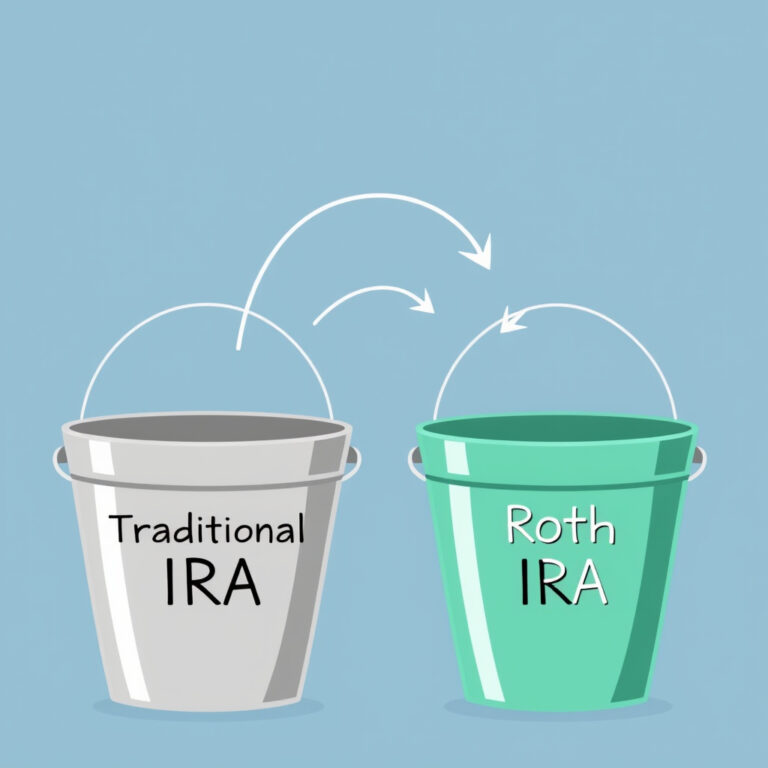
A Roth conversion moves money from a traditional IRA into a Roth IRA. You pay income tax on the amount you move this year. The added income can also raise your Medicare premiums two years later and the tax on your Social Security. In return, your traditional balance and future RMDs could be smaller, and Roth IRAs have no RMDs for the owner. Synergy’s guide to getting your money into a Roth explains how conversions work.
Coordinate Withdrawals From Taxable, Tax-Deferred, and Roth Accounts
The order you pull from your accounts changes your taxable income each year. Pulling some from a traditional IRA in a low-income year can spread the tax out. Using a taxable brokerage account or a Roth in a higher-income year can keep you under a bracket or IRMAA line.
Consider Qualified Charitable Distributions If Eligible
Once you’re 70½, you can give money straight from your IRA to a charity. This is called a qualified charitable distribution, or QCD. It isn’t counted as taxable income, but you can’t also deduct it as a donation.⁷ The total limit is $108,000 a year,⁷ and a QCD can count toward your RMD.⁸ Synergy’s page on qualified charitable distributions covers the details.
Review Social Security Timing and Other Income Sources
When you start Social Security changes how much room you have for planned withdrawals or conversions. So does the timing of a pension or part-time work. Synergy’s article on your Social Security benefits walks through claiming decisions.
Why RMD Planning Belongs in a Broader Retirement Tax Strategy
A move that lowers one cost can raise another. A big Roth conversion might shrink future RMDs but trigger IRMAA two years later. Skipping conversions might keep Medicare costs down now but leave a surviving spouse with large RMDs in a single filer’s bracket.
That’s why RMDs can be considered as part of a multi-year plan that covers federal and New Jersey taxes, Medicare, Social Security, and your family. Synergy’s tax planning approach includes reviewing Roth conversion opportunities every year and looking at charitable giving from IRAs.
RMD Tax FAQs
1. Can I Take My Whole RMD at the End of the Year?
Yes. You can take your RMD all at once, as long as you take it by the deadline. In most years that’s December 31. In your first RMD year, you can wait until April 1 of the next year. Waiting means you’ll take two RMDs in that second year, which can raise that year’s taxable income.²
2. Does My RMD Count as Income for IRMAA?
Yes. Your RMD is part of the modified adjusted gross income (MAGI) that Medicare uses to set IRMAA. Medicare looks at your tax return from two years earlier, so a large RMD in 2026 could affect your 2028 premiums.⁶
3. Should I Have Taxes Withheld From My RMD?
You can ask to have federal tax withheld from your RMD. That can help you avoid owing a large amount at tax time. The right amount depends on your other income, deductions, and how much of your Social Security is taxable.
4. Do I Still Take RMDs If I’m Working Past 73?
It depends on the account. If you’re still working and don’t own 5% or more of the business, you can usually delay RMDs from your current employer’s plan until you retire. Traditional IRAs still require RMDs at 73, even if you’re working.²
Planning Your RMDs With Synergy Wealth Management
Synergy Wealth Management looks at how your future RMDs fit with your federal and New Jersey taxes, your Social Security, your Medicare premiums, and your income plan. That includes looking at Roth conversions, withdrawal order, and charitable giving side by side, so you can see the trade-offs before RMDs begin.
If RMDs are a few years away or have already started, a conversation can show you where you stand. Contact Synergy Wealth Management to talk through how your RMDs may affect your taxes.
Resources:
- Retirement Benefits, Social Security Administration
- Retirement Plan and IRA Required Minimum Distributions FAQs, Internal Revenue Service
- Required Minimum Distribution (RMD) Rules for Original Owners of Retirement Accounts, Congressional Research Service
- Publication 590-B, Distributions From Individual Retirement Arrangements (IRAs), Internal Revenue Service
- Must I Pay Taxes on Social Security Benefits?, Social Security Administration
- Medicare Costs, Medicare.gov
- Publication 526, Charitable Contributions, Internal Revenue Service
- Retirement Plans FAQs Regarding IRAs Distributions (Withdrawals), Internal Revenue Service
Disclosure: Investment advice offered through Stratos Wealth Advisors, LLC, a registered investment advisor. Stratos Wealth Advisors, LLC and Synergy Wealth Management are separate entities. Neither Stratos nor Synergy Wealth Management provides legal or tax advice. Please consult legal or tax professionals for specific information regarding your individual situation.