
Key Takeaways:
- A Roth conversion means paying tax now for a possible tax break later. The years before your required withdrawals start may give you room to convert at a lower cost. Whether it pays off depends on your own numbers.
- Your tax bracket is only the first thing to check. A conversion can also raise your Medicare premiums, increase the tax on your Social Security, and change your New Jersey tax bill.
- The choice works should be evaluated as part of a plan that covers several years. Your timeline, your spouse, where the tax money comes from, and who inherits your accounts all affect whether converting makes sense.
About 18.9% of people in the United States were 65 or older in 2025, according to the U.S. Census Bureau.¹ At the same time, traditional IRAs held about $15.9 trillion at the end of 2025.² A traditional IRA (individual retirement account) and most 401(k) plans let you skip paying income tax on that money while you save. The tax comes due later, when you take the money out.
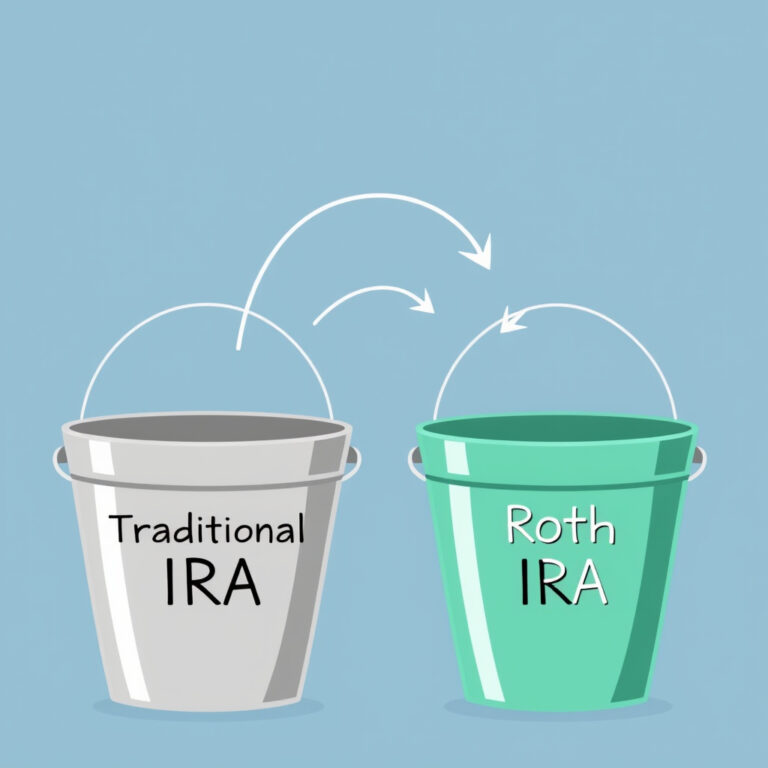
Retirement is when you get some say over when that tax is paid. At a certain age, the IRS makes you start taking money out each year. These withdrawals are called required minimum distributions, or RMDs. Before they begin, you can move some of your money into a Roth IRA, which is called a Roth conversion. The question is whether paying tax on that money now could leave you with a smaller tax bill over your lifetime.
Why Consider a Roth Conversion Before RMDs Begin?
A Roth conversion before RMDs may make sense if your income is lower now than it will be once required withdrawals start. You pay income tax on the amount you convert this year. In return, that money has the potential to grow, and qualified withdrawals from the Roth may be tax-free, as long as you follow the rules.
RMDs generally begin at age 73.³ Under current federal rules, the starting age is 73 for people born from 1951 through 1958 and 75 for people born in 1960 or later.⁴ If you were born in 1959, check your start age with a tax professional. Each year’s RMD is based on your account balance at the end of the prior year, so a larger balance generally means larger required withdrawals.³
The years between retiring and your first RMD often come with lower income. Your paycheck has stopped, and you may not have started Social Security yet. We walk through how to use those years in The Retirement Tax Window. Converting is one choice for those years, and it isn’t always the right one. For how conversions work step by step, see our guide to getting your money into a Roth.
When Converting Earlier May Make Sense
Converting before RMDs may be worth a closer look in a few situations:
- Large pre-tax balances: If your traditional IRA or 401(k) is large, your future RMDs could push you into a higher tax bracket. A tax bracket is the rate you pay on your next dollar of income. Converting some money earlier lowers the balance that future RMDs are based on.
- Several low-income years ahead: Having a few years before RMDs start lets you convert smaller amounts each year. Spreading conversions out may keep each year’s income in a lower bracket.
- Cash to pay the tax: Paying the conversion tax from a savings or brokerage account allows the full converted amount to remain in the Roth, where it has the potential for tax-free growth.
- Protecting a surviving spouse: After one spouse dies, the other usually files as a single taxpayer. Single filers reach higher brackets at lower income levels, so the same RMDs could be taxed more heavily.
- Leaving money to heirs: Most beneficiaries who aren’t a spouse must empty an inherited retirement account within 10 years.⁶ Inherited traditional IRA money is taxed as it comes out, while qualified Roth withdrawals generally aren’t. That makes a Roth one option to weigh, though it isn’t always the best estate choice. Our article on estate planning covers the bigger picture.
Timing matters for one more reason. Roth IRAs don’t have RMDs while you’re alive.³ You can still convert after RMDs begin, but the IRS says the amount you’re required to withdraw for a year can’t be converted.⁵ You’d have to take that year’s RMD first and pay tax on it, then convert on top of it. Converting earlier avoids stacking those two amounts in the same year.
When a Roth Conversion May Not Be Worthwhile
Converting doesn’t help everyone, and paying tax early can cost you if the numbers don’t work out. A conversion may not be worthwhile if:
- Your tax rate later may be lower: If you expect your income to drop further in later years, paying tax now could mean paying at a higher rate than you otherwise would.
- You’d pay the tax from the IRA itself: Using converted money to cover the tax shrinks what lands in the Roth. If you’re under 59½, the money held back for taxes may also face a 10% early-withdrawal penalty.⁵
- It could trigger other costs: Extra income from a conversion can raise your Medicare premiums or make more of your Social Security taxable. Those costs are covered in the next section.
- You have a short time frame or a modest balance: A longer time horizon may provide more opportunity for potential tax-free growth to offset the upfront tax cost. With only a few years left, or smaller RMDs ahead, the math may not work.
- You plan to give to charity: Starting at age 70½, you can give money straight from an IRA to a charity through a qualified charitable distribution, or QCD. A QCD can count toward your RMD without adding to your taxable income. If giving is part of your plan, keeping some money in a traditional IRA may make sense. You can read more about qualified charitable distributions.
The Tax and Retirement-Income Factors to Evaluate
A conversion raises your income for the year, and several other parts of your finances react to that change. Each of these affects what a conversion truly costs:
Federal bracket room: This is how much income you can add before reaching the next tax bracket. Many people convert just enough to fill their current bracket without moving into the next one.
Medicare premiums (IRMAA): IRMAA stands for income-related monthly adjustment amount. It’s an extra charge on Medicare premiums for people above certain income levels. Social Security generally uses your income from two years earlier, so a conversion you make at 63 can raise the premiums you pay at 65.⁷ The income levels work like cliffs, where going $1 over can move you into the next price tier. Learn more in our IRMAA guide.
Taxes on Social Security: The IRS uses a figure called combined income (sometimes called provisional income) to decide how much of your Social Security gets taxed. It adds your adjusted gross income, any tax-exempt interest, and half of your benefits. Once combined income is above $32,000 for married couples filing jointly, up to 85% of benefits can be taxable.⁸ A conversion adds to that total. Our article on planning for your Social Security benefits explains how timing your claim fits in.
New Jersey income tax: New Jersey follows the federal rules on whether you can convert.⁹ The part of your conversion that hasn’t been taxed by New Jersey before counts as income on your state return.⁹ That matters because New Jersey’s retirement income exclusions, which let you leave some pension and IRA income off your state return, have a total income limit of $150,000.¹⁰ Anyone with total income of $150,001 or more can’t claim the pension exclusion at all.¹⁰ Our guide to how retirement income is taxed in New Jersey covers the exclusions in detail.
Consider a hypothetical example, used only for illustration. A married couple in New Jersey, both age 66, expects about $140,000 of total income this year, which keeps them under the state limit. A $20,000 conversion would raise their total income to about $160,000. That could cost them their pension exclusion for the year, on top of the tax due on the conversion itself. A smaller conversion that keeps their income under $150,000 could avoid that loss. Your results would depend on your own income, filing status, and tax situation.
Where the tax money comes from: Paying the tax from cash outside your retirement accounts may allow the full converted amount to remain invested in the Roth. Whether a conversion is beneficial will depend on several factors, including investment performance, spending needs, and the length of time the assets remain invested.
How to Evaluate the Decision Within a Long-Term Retirement Plan
One way to test a Roth conversion is to compare several versions of the next 10 to 20 years. Those might include converting nothing, converting a small amount each year, or converting more in the years before RMDs start. Each version should show your federal tax, New Jersey tax, Medicare premiums, and Social Security taxes year by year.
Sometimes the answer will be to convert a set amount each year until RMDs begin. Other times, it’s “not this year,” because a home sale, a large bonus, or the Medicare lookback makes the timing poor. Your numbers can also shift as tax laws, markets, and your health change, so the plan is worth reviewing each year. To see how conversions fit with your other retirement tax choices, read our guide to tax-efficient retirement planning in New Jersey, or learn about our tax planning services.
Roth Conversion Before RMDs FAQs
1. Does a Roth Conversion Count Toward Your RMD?
No, a Roth conversion doesn’t satisfy your required minimum distribution. Once RMDs apply, you must take that year’s RMD first, and the required amount itself can’t be converted.⁵
2. How Much Tax Would You Pay on a $50,000 Roth Conversion?
It depends on your other income, your filing status, and your deductions. The $50,000 is added to your taxable income for the year, so part of it may be taxed at a higher rate than the rest. In New Jersey, the conversion may also count toward your state income and the $150,000 retirement exclusion limit.⁹ ¹⁰
3. Can You Still Do a Roth Conversion After RMDs Start?
Yes. You can convert after RMDs begin, but you must take the full RMD for that year first.⁵ The RMD and the conversion are both taxable, so the combined income can be higher than if you had converted earlier.
4. Is There a Waiting Period Before You Can Withdraw Converted Money?
Yes, in some cases. Each conversion has its own five-year period. If you take out converted money within five years and you’re under 59½, you may owe a 10% additional tax on it.¹¹ Earnings in the Roth have their own rules for tax-free withdrawal.
5. Can You Undo a Roth Conversion?
No, conversions made in 2018 or later can’t be reversed, or “recharacterized,” back into a traditional IRA.⁵ That’s why it’s important to run the numbers before you convert.
Talk With Synergy About Roth Conversions and Your Retirement Tax Plan
At Synergy Wealth Management, the client and I look at Roth conversions as a tax decision first. We model how a conversion could affect your federal and New Jersey taxes, your Medicare premiums, and your Social Security over several years, then help you decide how much to convert and when, if at all.
If RMDs are a few years away and you’re weighing a conversion, I’d be glad to review your situation with you. Schedule a free consultation to get started.
Resources:
- Global Older Adult Population Projected to Nearly Double by 2060, U.S. Census Bureau
- 2026 Investment Company Fact Book, Chapter 8, Investment Company Institute
- Retirement Topics: Required Minimum Distributions (RMDs), Internal Revenue Service
- Required Minimum Distributions, Final Regulations, Federal Register
- Publication 590-A, Contributions to Individual Retirement Arrangements (IRAs), Internal Revenue Service
- Retirement Topics: Beneficiary, Internal Revenue Service
- How Is the Income-Related Monthly Adjustment Amount Determined?, Social Security Administration
- Income Taxes and Your Social Security Benefit, Social Security Administration
- Roth IRAs, New Jersey Division of Taxation
- Retirement Income Exclusions, New Jersey Division of Taxation
- Publication 590-B, Distributions from Individual Retirement Arrangements (IRAs), Internal Revenue Service
Investment advice offered through Stratos Wealth Advisors, LLC, a registered investment advisor. Stratos Wealth Advisors, LLC and Synergy Wealth Management are separate entities. Neither Stratos nor Synergy Wealth Management provides legal or tax advice. Please consult legal or tax professionals for specific information regarding your individual situation.
Investing involves risk, including the potential loss of principal. No investment strategy can guarantee a profit or protect against loss.
The information on this page is for informational and educational purposes only and should not be considered personalized investment advice.
For more information about Synergy Wealth Management’s services, fees, and business practices, please review our Form ADV Part 2A, available upon request or at adviserinfo.sec.gov.