
Key Takeaways:
- Retirement can temporarily lower taxable income. Employment income often drops before other retirement income sources or RMDs fully take over.
- This window isn’t automatically a low-tax period. Whether it creates real planning room depends on your pensions, Social Security, investments, and overall retirement income.
- The goal is a better multiyear outcome, not just a lower bill this year. Roth conversions, withdrawals, and gain harvesting should be judged against your future tax picture, including RMDs.
Retirement can materially change your tax picture. Wages and other employment income may disappear or decline substantially, while pensions, Social Security, and required distributions from retirement accounts may not have started yet.
The years before required distributions begin can create tax-planning flexibility for some retirees. This isn’t automatically a low-tax period, and whether the opportunity exists depends on your actual income, assets, retirement timing, and broader tax situation.
Why the Years Between Retirement and RMDs Can Create a Tax Window
Several factors interact to determine whether this period actually opens up planning room:
Employment Income May Drop: Wages and other employment income often decline sharply after retirement, reducing taxable income compared with your peak working years.
RMDs Have Not Added Mandatory Income Yet: Pre-tax retirement assets may still be growing while distributions remain optional. The RMD start age depends on birth year, so this window’s length varies by retiree.4
Other Retirement Income Can Narrow the Window: Pensions, Social Security, deferred compensation, investment income, and part-time earnings can already consume some or all of the apparent planning room.
Available Tax-Bracket Room May Expand: Once employment income falls, some retirees have more room to intentionally recognize taxable income before reaching a higher marginal bracket. That capacity is what can make the pre-RMD period useful for proactive planning.
Please note: A tax window doesn’t necessarily mean a “tax holiday.” The goal isn’t automatically to minimize this year’s tax bill. The more useful question is whether intentionally recognizing some income now could improve your tax position over the full course of retirement.
How to Set the Guardrails for the Pre-RMD Planning Period
Before deliberately creating additional taxable income, it helps to establish how much planning room actually exists:
Projected Retirement Income: Start with the taxable income already expected for the year, including pensions, Social Security, interest, dividends, deferred compensation, and part-time earnings. This sets the baseline before adding any optional income.
Marginal Tax-Bracket Room: Retirees can assess how much additional ordinary income they can recognize within a targeted federal bracket. Filling a bracket shouldn’t be an automatic goal, since the real comparison is between today’s tax cost and the projected tax consequences later.
Capital Gains Exposure: Ordinary income and investment gains need to be modeled together. Some long-term capital gains may qualify for a 0% federal rate depending on taxable income, so a Roth conversion or IRA distribution can affect how much room remains for gain harvesting.1
Health Coverage Income Thresholds: Additional income can have consequences beyond the tax bracket. For Medicare beneficiaries, a higher MAGI can affect IRMAA for Part B and Part D, generally using income from two years earlier.2. Retirees on Marketplace coverage should also consider how income affects premium assistance.
How to Use Tax Windows Strategically Between Retirement and RMDs
Once you understand how much income-recognition capacity may exist for the year, the next step is deciding whether using part of it could improve your longer-term tax picture.
The available tools have different purposes. Some reduce future pre-tax balances, some take advantage of favorable capital-gains treatment, and others coordinate with charitable goals. Evaluate the right combination across multiple tax years, not one year at a time.
Use Roth Conversions and Intentional IRA Withdrawals to Reduce Pre-Tax Balances
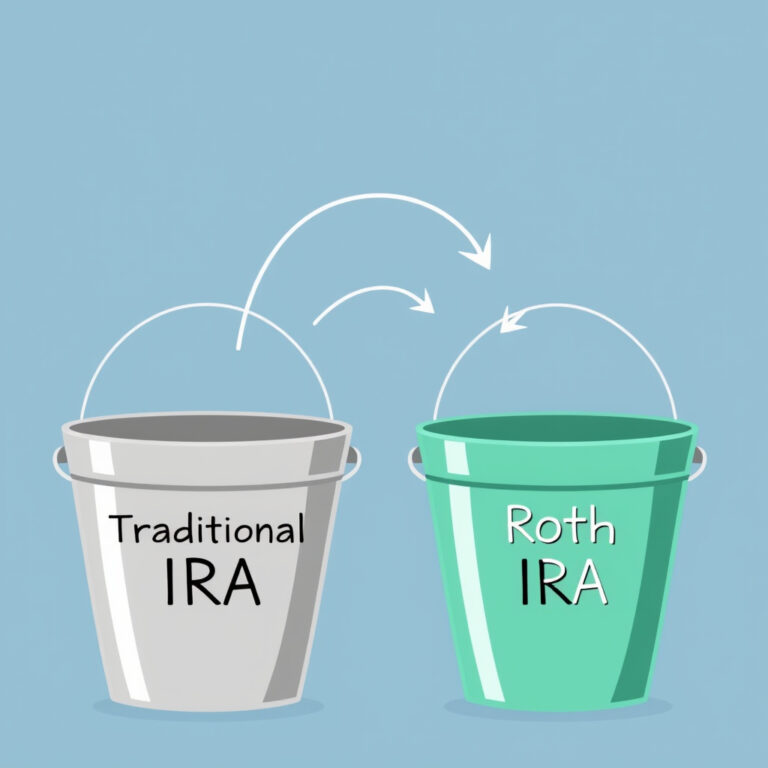
A Roth conversion deliberately moves money from a pre-tax retirement account into a Roth account, generally creating taxable income in the conversion year. The tradeoff is paying tax now while reducing the balance that could generate future RMDs.
An intentional IRA withdrawal accomplishes something different. A retiree who already needs portfolio money for spending may draw some of that cash from a traditional IRA before distributions become mandatory, recognizing income while shrinking the future pre-tax balance.
The two are worth comparing at a high level. A conversion keeps the money invested inside a retirement account, while a withdrawal generally moves it out for spending. The choice should reflect today’s tax rate, expected future income, and what you need the money to do.
Harvest Capital Gains During Lower-Income Years
Retirees with appreciated taxable investments may be able to intentionally realize long-term gains in a year when taxable income is lower. Depending on total taxable income, some of those gains may fall within the 0% federal rate.1
Selling an appreciated position and, when appropriate, reinvesting can establish a higher cost basis, potentially reducing the embedded gain left for a future sale.
Gain harvesting competes for the same annual capacity as conversions and withdrawals, so coordinate the amount realized with the guardrails above rather than treating it as a separate decision.
Coordinate Charitable Giving With the Later Years Before RMDs
Charitably inclined IRA owners may become eligible for qualified charitable distributions at age 70½, potentially before their RMDs begin.3. A qualifying distribution goes directly from the IRA to an eligible charity and can exclude the transferred amount from taxable income.
This creates a window to use QCDs even before mandatory distributions begin, adding another tool for the years between retirement and RMDs.
Once RMDs begin, qualifying QCDs can count toward satisfying all or part of the year’s RMD, making charitable intent worth building into the strategy before mandatory distributions arrive.
How a Retirement Tax Window Can Shape Future Tax Exposure
Leaving pre-tax retirement accounts untouched can feel tax-efficient while distributions are optional, but those balances may keep growing and eventually produce larger required distributions. The value of today’s strategy depends partly on what it prevents or preserves later.
Before deciding how aggressively to use these years, it helps to project the major issues ahead:
- Estimate how large traditional IRA and employer-plan balances could be when RMDs begin and what those required distributions may look like under reasonable growth assumptions.
- Layer those future distributions on top of expected Social Security, pension income, investment income, and other recurring sources to see how much taxable income may already be present.
- Compare that projected later tax picture with the cost of recognizing additional income voluntarily during the years before required distributions begin.
- Evaluate whether today’s conversions, withdrawals, or other planning moves materially improve future flexibility rather than simply shifting taxes from one year to another.
- Revisit the projection regularly as account values, spending needs, retirement income, tax law, and personal circumstances change.
Retirement Windows and Pre-RMD Tax Planning FAQs
1. What Is the Best Time of the Year to Retire for Tax Purposes?
There’s no single best date. Retiring earlier in the year generally means less employment income for that tax year, which can create more room for additional planning.
2. Is It Better to Take RMDs Monthly or Annually?
The tax result is generally the same either way, since RMDs are taxed as ordinary income regardless of timing. The choice usually comes down to cash-flow preference.
3. What Is the Best Way to Take RMDs From Your Retirement Accounts?
It depends on which accounts you hold and your broader income picture. Some retirees aggregate RMDs across similar IRAs, while others coordinate timing with other income or charitable giving.
4. How Do You Minimize Taxes When Taking RMDs?
Strategies vary by situation, but options include earlier Roth conversions, qualified charitable distributions, and coordination with other income in the same tax year.
5. Should You Do Roth Conversions Before RMDs Begin?
It depends on your current tax bracket compared with your expected future bracket, including the effect of future RMDs. What makes sense for one household may not make sense for another.
6. Can You Make a Qualified Charitable Distribution Before RMDs Begin?
Yes. QCD eligibility begins at 70½, which may come before RMDs start depending on your birth year, so that you can use a QCD even without a current RMD requirement.3
Get Help Planning the Years Between Retirement and RMDs
The period after employment income ends but before RMDs begin can provide real tax flexibility, but simply paying as little tax as possible during those years may not produce the strongest long-term outcome.
A financial advisor can model the years ahead and help coordinate bracket management, Roth conversions, intentional IRA withdrawals, capital-gain harvesting, charitable giving, Medicare considerations, and projected RMD exposure as one strategy.
Coordinating this planning with a qualified tax professional also helps ensure implementation reflects your actual tax return. If you’d like help thinking through how to use the years between retirement and RMDs, we invite you to schedule a complimentary consultation with our team.
Resources:
1. Topic no. 409, Capital Gains and Losses, Internal Revenue Service
3. Retirement Plans FAQs Regarding IRA Distributions (Withdrawals), Internal Revenue Service
4. Retirement Plan and IRA Required Minimum Distributions FAQs, Internal Revenue Service